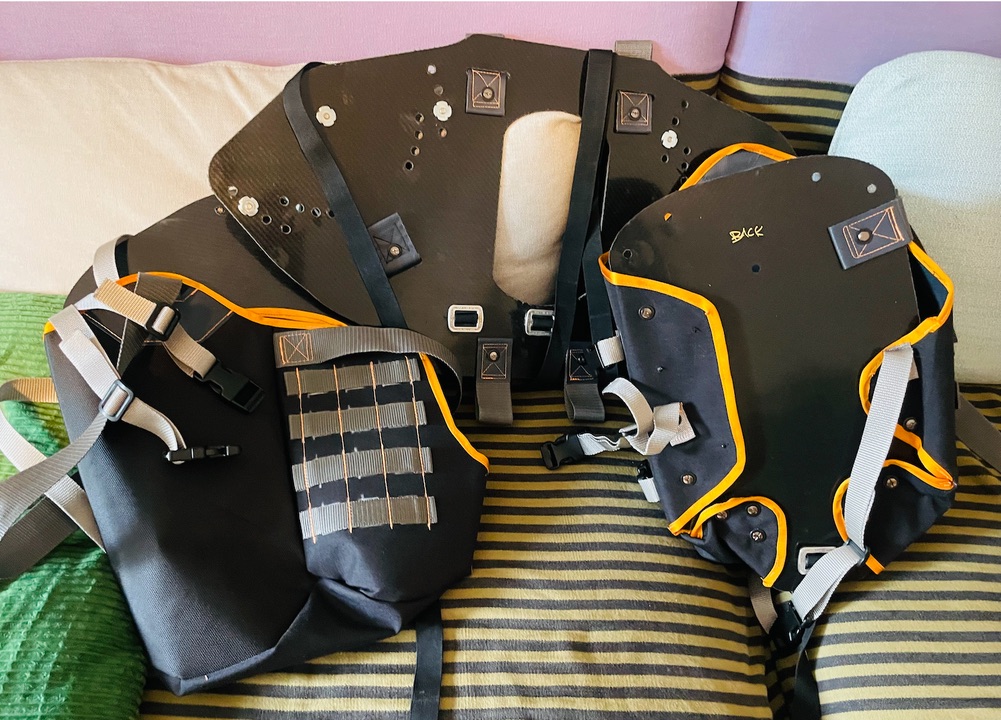
I just came back from the maiden voyage (about 2000 km including a bit of off-road, with a BMW R1100 GS) with my new “rackless” (meaning you don’t need a luggage rack, you just throw it over like saddlebags) motorcycle luggage system, which I’ve named TMS.GL Wreck60. The 60 stands for 2×30L that can be carried as sidebags (in the form of drybags). On top you can strap on whatever you want 😉
The system is heavily inspired (copied…) from the brilliant Mosko Moto rackless luggage system: Reckless 80L. I will not put any images of it here because I could not find any license information.
To be honest, the price of around €1300 (including shipping to Germany) was a
little bit too much for me (btw. after weeks of work, I totally understand where
the price comes from ;), and side note: the price went down a lot in the past
months!) and I could not find any reseller in Germany where I could put my hands
on to see how it feels and fits, and since I love to tinker and create my own
gear, I came up with the idea to build it myself from scratch and tweak it to my
taste.
Materials
I went through a lot of descriptions and information about the system, including the used materials and the overall modular design.
I made the baseplates from the same material (Curv® and copied the shapes from product photos enough that it might even be compatible. I’ve never seen the original in real life though, so I can’t judge.
Curv® is actually the reason I ended up here – I found the material at Tacticaltrim in the shop! I’m quite happy about that 😄
Here are some details about the materials (I’ll also publish a more detailed guide + sewing patterns):
- The baseplate and the two sideplates are made from 2 mm Curv® from Tacticaltrim (I currently only see 1.68 mm – have the 2 mm sheets been discontinued?)
- “Sidebag holsters” are made from three layers:
- Binding tape
- Polyester sewing thread: Gütermann Mara 70
- 25 mm and 38 mm webbing, buckles, D-rings, etc.
- Flat insert nuts to connect the baseplate with the sideplates
- Flat Torx screws for the insert nuts
- M5 Chicago screws to connect the holster to the sidebags
I intentionally avoided rivets because I find Chicago screws way more practical (I like everything that you can easily take apart and put back together 😉). With medium-strength Loctite, nothing came loose after 2000 km, and I just carry a few spare screws in case any get lost.
Tools
Here are the tools I am using (Amazon affiliate links):
- Singer Heavy Duty 4423 - 90W with a single jeans
needle. Yes, with this machine you can sew 2xPVC (600D) + 2xCordura® (1680D) +
0.35 Curv + binding tape + 38 mm webbing — so seven layers in total. It takes
some force and you have to push a bit when starting thick/multiple layers, but
it works
;)I only had this crazy combination over about a meter of stitching — most is just four layers (PVC and Cordura®). - Hole punch
- Laser cutter/waterjet for the 2 mm Curv (yes, unfortunately there’s no other way)
The Wreck
The whole thing is mounted at the rear with three quick straps, and with two straps each on the passenger footpeg bars. Super stable! Then you slide a drybag into each side holster, attach the side buckles of the drybags to the Curv sideplates (with the counterpart buckles mounted using screws), close the wide buckle in the middle on top, and on the very top of the baseplate you can secure another drybag with two wide replaceable straps.
I still want to optimize a few small details: replace some buckles with metal G-buckles to make fastening and release quicker. Other than that I’m absolutely thrilled — the guys from Mosko Moto really developed a fantastic idea, hats off. Much better (and safer) than the aluminum panniers I had years ago, and better than saddlebags like the Enduristan Monsoon 3, which were very wide and shifted the weight far backward. The principle of this rackless system is that the luggage sits much closer to the rider, basically under the thigh. That gives you much better handling offroad.
All in all I can definitely understand why the price is four figures. With everything included I ended up at about €350 in material costs. The most expensive part was the Curv plates at around €250. They’re supposed to be indestructible 😉
In total I spent around €700 on the project including a used Singer Heavy Duty machine for €200.
Here are a couple of pictures — the first one is in front of the Hungarian nuclear power plant in Paks ;D

Making of…


